What Cuts of Beef Are Not Kosher
This post has been a long time in coming. And not only considering it's taken me a while to write it. Just because it's taken me a while to learn it. Like many domicile cooks, when it came to meat grooming, I was stumped. I didn't understand the dissimilar cuts of meat or how to set them. After lots of reading, and a hands-on butchery class at The Center for Kosher Culinary Arts, I feel like I finally take a adept grasp of kosher meat preparation and handling.
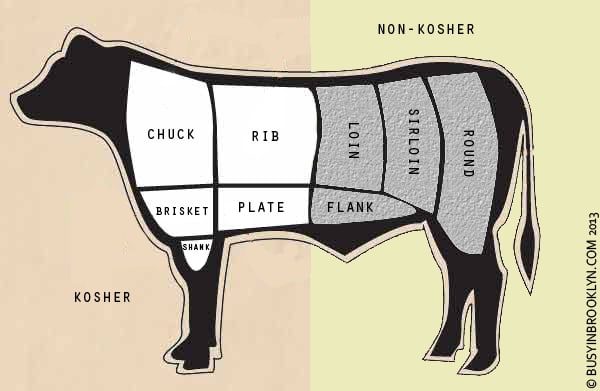
Outset things first: Where does the meat that we eat actually come from? The different cuts of meat that yous buy at the butcher come from a steer. The steer is cut upwardly into 9 sections, or Central CUTS, five of which are kosher. The chuck, rib, brisket, shank and plate are cut into subprimals or made cuts, which is what y'all run into at the supermarket.
The near of import thing to sympathize about the beefiness that we consume is where it comes from. Meat is made up of muscle and connective tissue. The more the musculus is used, the more connective tissue it volition have causing the meat to be tough. For example, the chuck, which is the shoulder of the steer, is one of the most used parts of the fauna resulting in a tough cut of meat.
Why does it matter where our meat comes from? Well one time we understand the nature of the meat (if it'due south tough or tender) we volition know what type of cooking method it requires. Tough cuts of meat needs moist cooking to break down the muscle fibers and connective tissues. Tender cuts require dry heat cooking methods to firm upward the meat without drying it out.
At present, allow'due south get into made cuts and how they are broken downwards.
Unfortunately, for the kosher consumer, it'due south difficult to know what you're really getting in the butcher shop. Kosher butchers (and butchers in full general) tend to name their cuts even so they like. That existence said, these are the almost general fabricated cuts that you'll find:
CHUCK:
Chuck roast is often sold tied in a net and includes the Square Roast (elevation portion) and the French (or Brick) Roast (lesser portion). Since the chuck portion is very tough, it is ofttimes cubed and sold as stew meat also. Kolichol is another tough cut from the shoulder section, and is not bad to use in the cholent or wherever a recipe calls for pot roast. Unlike chuck roasts that require moist heat cooking to tenderize the meat, Shoulder London Bake & Argent Tip Roasts (used to brand Roast Beef) that are as well cut from the shoulder, tin can be roasted using a dry estrus cooking method until medium-rare.
Ane of the most pop and tender cuts from the shoulder is the minute steak roast. Y'all would probably recognize it from the thick slice of gristle that runs down the center. When the roast is sliced horizontally above and below the gristle, the resulting cuts are oftentimes called filet split and are perfect for quick cooking in stir fry's or wherever recipes call for quick grilling (such as london broil or flat iron steak).
A notation about London Broil: London Bake is non actually a cut of meat, only rather a method of preparing the meat by broiling or grilling marinated steak and and then cutting it across the grain into sparse strips. Butchers use different cuts of meat for this, some more and some less tender. If you are curious every bit to where the London Broil is cut from, simply ask your butcher.
RIB:
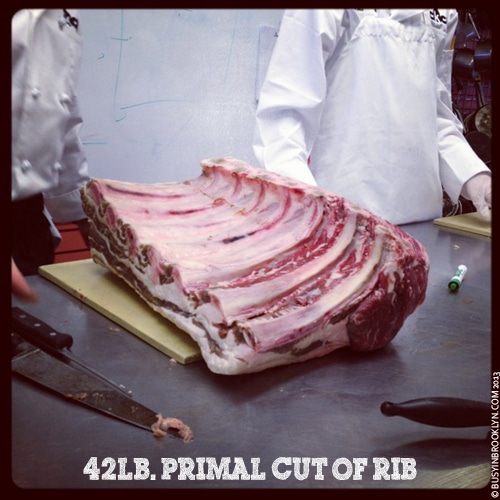
Ribs are the well-nigh tender cut of kosher meat because the muscles in this area are not worked as much. Ribs should ever be cooked using a dry rut cooking method. The rib section includes, rib steaks, ribeye steaks, club steaks, delmonico or mock filet mignon (which uses the heart Center of the rib). There is also a peachy cut known as the Surprise steak – a flap that covers the prime rib and is tender and succulent. Above the surprise steak is the "Top of the Rib" which some butchers call the "Deckle". This is the one exception to the dominion of the rib section. Top of the Rib is a tougher cuts and benefits from moist heat cooking.
Besides the rib central, ribs can also be institute in the chuck primal, which includes the first 5 ribs of the ribcage. That is where flanken and short ribs comes from. Brusk ribs are strips of meat & fat that are cut from betwixt the ribs, while flanken is a cantankerous-department cut, including pieces of the rib in betwixt the meat & fatty. Spare ribs are short ribs that take been cut in half lengthwise. Both short ribs and flanken benefit from moist rut cooking.
PLATE:
The plate sits beneath the rib primal and includes the flavorful skirt and hanger steaks. Both take a high common salt content and benefit from quick grilling.
BRISKET:
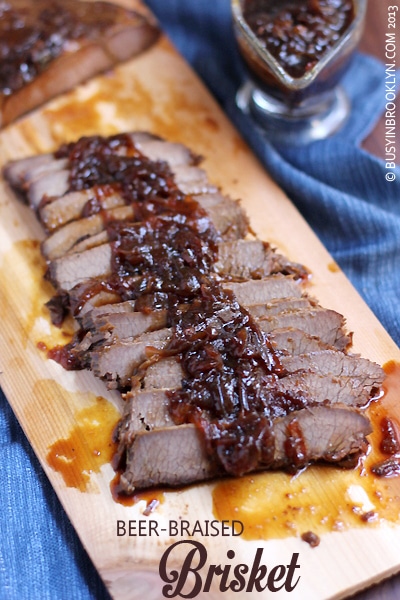
Brisket is the breast of the steer and is an extremely tough cutting. A whole brisket tin can weigh every bit much equally 15 lbs. Brisket is often sold as 1st and 2nd cut. First cutting brisket is flat and lean. It is much less flavorful than the second cutting, which is smaller but fattier. In general, fattier meat will always yield a tastier product. Fat is flavor, and so when possible, always opt for a well-marbled cut over a bacteria one. You can always refrigerate the meat and remove the congealed fatty later on.
Start cutting of brisket tends to cutting nicely, while 2nd cutting tends to shred, making information technology perfect for pulled beef. Corned beef & pastrami are popularly fabricated from brisket. Corned beef is pickled while pastrami is smoked.
FORESHANK
The foreshank is very flavorful and high in collagen. It includes the shin and marrow bones. Considering collagen converts to gelatin when cooked using moist heat, foreshanks are splendid for making stocks.
ADDITIONAL PARTS
In addition to the key cuts of the animal – there are other edible parts of the steer including the neck (mostly used ground up due to it's connective tissues), cheek (nifty for braising), sweetbreads (thymus gland), liver, natural language and oxtails (hard to find kosher due to the complications involved in removing the sciatic nerve).
GROUND Beef
Ground beef can come up from any function of the beast, simply it is normally fabricated from lean cuts and trimmings. Grinding the meat helps to tenderize information technology, and then the toughest cuts are often used. When purchasing ground beef, keep in mind that the leaner the meat, the drier your end production will be. 80% lean to xx% fat is a good ratio.
OTHER CUTS NOT MENTIONED
There are lots of different cuts available that are not mentioned here, and the reason for that is considering every butcher has different scraps and pieces of leftover meat that they choose to label at their own convenience. Pepper steak at 1 butcher might come from the chuck and at another butcher, from the deckle. If you lot desire to use your meat for a specific purpose, and you don't want to have to braise information technology for a long fourth dimension in order to tenderize it, order a specific cut from your butcher, or ask where the prepackaged meat comes from.
GRADING
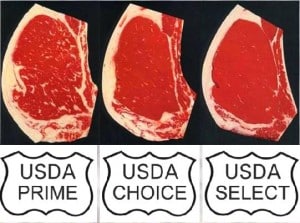
All meat is graded past the USDA to ensure that it is fit for human consumption. Grading provides a system by which distributor (and consumers) can measure out differences in quality of meats. Grades determine the tenderness and flavour of the meat base on its age, colour, texture and caste of marbling. USDA Grades include: Prime, Choice, Select and Standard. You've probably heard of USDA Prime Form meats. They are frequently used in fine restaurants. USDA Option is the most commonly used grade in food service operations.
COOKING METHODS:
Equally I mentioned above, once you know whether your meat is tough or tender (due to muscle movement & connective tissue) you will empathize how to melt it. Tough meat requires slow, moist oestrus cooking to help break down the connective tissue and tenderize the meat. Tender meat requires dry heat cooking to house up the proteins without breaking down connective tissue.
DRY Heat COOKING
Dry out rut cooking can include broiling, grilling, roasted or sauteing/pan-frying. Meat should be cooked at high temperatures to caramelize their surface. To decide doneness, check the temperature with a meat thermometer. Over fourth dimension, you volition learn to "feel" for doneness based on the meats resistance when poked with a finger.
Thermometer readings:
very rare (sometimes referred to as "blue" meat) 120-125
rare (deep red heart) 125-130
medium rare (bright red heart) 130-140
medium (pinkish center) 140-150
medium well (very little pink) 155-165
well done (all brownish) 165+
MOIST Rut COOKING
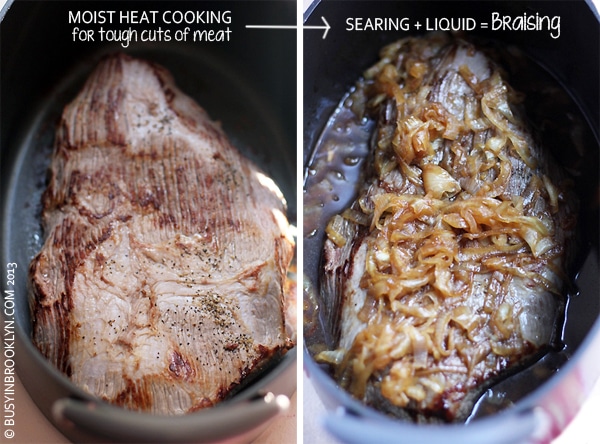
Moist heat cooking includes simmering (used for corned beef and tongue) and combination cooking methods: braising and stewing.
Combination cooking methods use both dry and moist heat to achieve a tender consequence. Meats are beginning browned and and then cooked in a small-scale amount of liquid. Wine and/or tomatoes are oftened used as the acid helps to break down and tenderize the meat. The meat and liquid are brought to a boil over directly oestrus, the temperature is reduced and the pot is covered. Cooking can be finished in the oven or on the stove top. The oven provides gentle, even heat without the risk of scorching. To make up one's mind doneness when braising or stewing, the meat should be fork tender only non falling apart.
The main differences between braising and stewing are that stewing uses small pieces of meat, while braising uses a single, large portion. In addition, braising requires liquid to embrace only ane/iii-one/2 of the meat while stewing requires that the meat be completely submerged in the liquid.
RESTING & CUTTING MEAT
When meat has finished cooking, it's e'er important to let it balance (10-20 minutes) earlier slicing. Resting allows the juices to redistribute themselves, and cutting into the meat too early will crusade all the juices to run out of the meat.
Another thing to keep in heed when cooking meat is CARRYOVER COOKING. When meat is finished cooking and removed from the heat, the internal temperature still continues to rise while the meat continues cooking. Therefore, keep in mind carryover cooking when using dry oestrus cooking methods. If yous are looking for a medium doneness, and you pull your meat off at 150 degrees, the meat will continue to melt until it's temperature reaches almost 155, resulting in medium well doneness.
As mentioned, meat is a group of musculus fibers that band together to form muscles. When cutting meat, it'south of import to cut against the grain (perpendicular to the muscle fibers) in order to shorten the musculus fibers so that they are more tender. Cutting parallel to the muscle fibers results in chewy, stringy cuts of meat.
MEAT RECIPES
beer braised brisket with onion gravy
pulled BBQ brisket
pepper steak with plum sauce
spaghetti squash bolognese
Rosh Hashanah roast
london broil with red vino reduction
Post a Annotate

Source: https://www.busyinbrooklyn.com/kosher-meat-guide-cuts-cooking-methods/
0 Response to "What Cuts of Beef Are Not Kosher"
Post a Comment