what order did the war production board give to the countrys automobile manufacturers?
Homefront Security
During World War Ii, millions of American civilians were recruited past civil defence government programs to serve as volunteers and aid the state of war attempt.
Learning Objectives
Examine the function of the Ceremonious Air Patrol and the Civil Defense force Corps in monitoring dwelling-forepart security during Globe War II.
Central Takeaways
Key Points
- Already before entering WWII, President Roosevelt established an organization whose task was to catechumen industries from peacetime work to war needs, classify scarce materials, establish priorities in the distribution of materials and services, and prohibit nonessential production. The name, character, and office of this system was redefined a number of times, only it finally became the War Production Board.
- On May xx, 1941 the Role of Noncombatant Defense (OCD) was created to coordinate land and federal measures for the protection of civilians in case of state of war emergency.
- In December 1941, the Ceremonious Air Patrol (CAP), the noncombatant auxiliary of the United States Air Force, was established. It commissioned civilians to patrol (mostly the declension and borders) and engage in search and rescue missions.
- The Civil Defense Corps organized approximately 10 million volunteers to fight fires, decontaminate following chemic weapon attacks, and provide beginning aid.
- In October 1942, the CAP as well launched a very successful cadet program that recruited and trained youth, with an emphasis on flying preparation.
Key Terms
- Quango of National Defense: A The states organization formed during World State of war I to coordinate resources and industry in back up of the war effort, including the coordination of transportation, industrial and agricultural production, fiscal back up for the war, and public morale.
- War Production Board: An agency of the United States government that supervised war production during World War II. President Franklin D. Roosevelt established it on Jan xvi, 1942, with Executive Society 9024.
- Ceremonious Air Patrol: A congressionally chartered, federally supported, not-profit corporation that serves as the official noncombatant auxiliary of the U.s. Air Force. During Earth War II, it recruited and trained American civilians to aid the war attempt.
- Ceremonious Defence Corps: An organization established during Globe State of war Two, under the Office of Noncombatant Defence force. It organized approximately 10 million volunteers to fight fires, decontaminate after chemical weapon attacks, provide first assist, and other duties.
Civil Defense: Background
The idea of civil defense began to come up of age, both worldwide and in the United States, during World War I, when it was unremarkably referred to equally "civilian defense." This was the first major war that required the interest and support of the full general population. The U.Due south. followed the British model and the efforts were formalized with the creation of the Council of National Defense (CND) on August 29, 1916. It consisted of half-dozen cabinet members (the secretaries of agronomics, commerce, interior, labor, navy, and war) and an unpaid civilian advisory commission, whose task was to investigate and advise the president and heads of executive departments on the strategic placement of industrial appurtenances and services for the potential and time to come use in times of state of war.
World War 2
Even before the 1941 attack on Pearl Harbor, the Council of National Defence was reactivated past Franklin Delano Roosevelt. Still, CND was replaced by the Office of Production Management in 1941, which was soon replaced by the War Product Board (WPB). The WPB directed conversion of industries from peacetime work to war needs, allocated scarce materials, established priorities in the distribution of materials and services, and prohibited nonessential production. Information technology rationed such commodities as gasoline, heating oil, metals, rubber, paper and plastics. It was dissolved shortly after the defeat of Japan in 1945, and was replaced past the Civilian Product Administration in belatedly 1945.
On May 20, 1941, the Office of Civilian Defense (OCD) was created to coordinate state and federal measures for protection of civilians in case of war emergency. Its two branches supervised protective functions, such as blackouts and special fire protection, and "war service" functions, such equally kid intendance, health, housing, and transportation. It was originally headed past New York Mayor Fiorello La Guardia, and was also charged with elevating national morale. The First Lady Eleanor Roosevelt served as assistant director of the OCD, and was particularly engaged in promoting the volunteer effort. Nether the OCD, the Civil Defense force Corps (CDF) were established. Past the finish of 1943, the CDF organized approximately 10 1000000 volunteers trained to fight fires, decontaminate after chemical weapon attacks, provide kickoff aid, and other duties.
Civil Air Patrol
La Guardia also formalized the cosmos of Civil Air Patrol (CAP), the civilian auxiliary of the U.s. Air Force, with Administrative Society 9, signed on December 1, 1941 and published December 8, 1941. The order outlined the Civil Air Patrol'south arrangement, and named its first national commander as Major General John F. Curry.
With America's entrance into World War Ii, German language U-boats began to operate along the east declension. Their operations were very effective, sinking a total of 204 vessels by September 1942. The CAP'southward top leaders requested that the State of war Department requite them the authority to directly combat the U-boat threat. The request was initially opposed, for the CAP was still a young and inexperienced arrangement. However, with the alarming numbers of ships being sunk past the U-boats, the War Department finally agreed to give CAP a chance.
On March 5, 1942, the government gave the CAP the authority to operate a coastal patrol at 2 locations along the eastward declension: Atlantic City, New Jersey, and Rehoboth Beach, Delaware. They were given a fourth dimension frame of ninety days to evidence their worth. The CAP's performance was outstanding, and earlier the ninety mean solar day menstruum was over, the coastal patrol operations were authorized to aggrandize in both duration and territory. By the end of the state of war, CAP pilots had flown more 500,000 mission hours.
Under the CAP and its Coast Guard counterpart, the Coast Baby-sit Auxiliary, civilians were trained to spot air raids, participate in search-and-rescue missions, and assistance with transportation. Towers were congenital in coastal and edge towns, and spotters were trained to recognize enemy aircraft. Blackouts were practiced in every city, even those far from the coast. All exterior lighting had to be extinguished, and black-out curtains placed over windows. The main purpose was to remind people that there was a state of war on, and to provide activities that would engage the ceremonious spirit of millions of people not otherwise involved in the war try. In big office, this effort was successful, sometimes almost to a mistake, such every bit in the plains states where many dedicated aircraft spotters took up their posts dark after night watching the skies in an area of the country that no enemy aircraft of that time could mayhap hope to attain.
At its height, The CAP operated 21 coastal bases in xiii states forth the Eastern Seaboard and the Gulf of Mexico. Originally, the Coastal Patrol was to be unarmed and strictly reconnaissance. The air crews of the patrol aircraft were to keep in touch with their bases and notify the Army Air Forces and Navy in the expanse when a U-boat was sighted, and to remain in the area until relieved. This policy was reviewed, however, when the CAP encountered a turkey shoot opportunity. In May 1942, a CAP crew were flying a littoral patrol mission off Greatcoat Canaveral when they spotted a German U-boat. The U-boat coiffure besides spotted the aircraft, but not knowing that information technology was unarmed, attempted to flee. The U-gunkhole became stuck on a sandbar, and consequently became an like shooting fish in a barrel target.
In October 1942, the CAP planned a programme to recruit and train youth, with an accent on flight training. The CAP cadets assisted with operational tasks and began indoctrination and training towards condign licensed pilots. Cadets were not exempt from being conscripted. To become a cadet, one had to be betwixt the ages of 15 and 17, and be sponsored by a CAP member of the same gender. The cadet program called for physical fitness, completion of the outset two years of high school and satisfactory grades. Information technology was open merely to native-born American citizens of parents who had been citizens of the United states for at to the lowest degree ten years. These restrictions were intentionally imposed to hold downward membership levels until a solid foundation could be established.
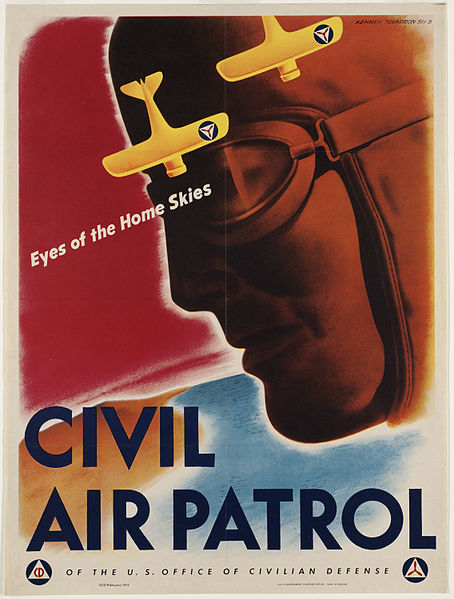
Optics of the Habitation Skies, 1943: Civil Air Patrol poster produced for the Office of Noncombatant Defense as part of a campaign to build interest in joining CAP during World War Two.
Economic Conversion
During the Second Globe War, the U.S. authorities took strong measures to convert the economy to meet the demands of state of war.
Learning Objectives
Describe how the War Product Lath and the transition to a wartime economy helped stimulate U.S. economic growth.
Key Takeaways
Key Points
- Following the New Deal exercise, the Roosevelt administration established a number of new government agencies, or expanded the office of those launched under the New Bargain, in club to catechumen the peacetime economic system to run into the requirements imposed by the war try.
- The War Production Lath (WPB) was the main U.Due south. agency whose task was to regulate the production of materials during Earth War II in the United States.
- By the end of 1943, two-thirds of the American economy was integrated into the war effort.
- In response to the constant shortage of resources, the U.Due south. government introduced astringent rationing measures.
- The unemployment trouble ended with the mobilization for war, hitting an all-time low of 700,000 in autumn 1944.
- The economic growth in response to the demands of World War II ended the Bang-up Low, and the United States transitioned into an unprecedented phase of prosperity.
Key Terms
- rationing: The controlled distribution of scarce resources, appurtenances, or services, or an artificial restriction of demand. Rationing controls the size of the immune portion of resources distributed on a particular day or at a item time.
- War Production Board: An bureau of the United States government that supervised war production during Globe War II. President Franklin D. Roosevelt established it on January sixteen, 1942, with Executive Gild 9024.
Background
Demands imposed by the U.South. participation in Globe War 2 turned out to be the most constructive measure to battle the long-lasting consequences of the Great Depression. The Roosevelt administration followed its New Deal approach and aimed to maintain significant control over the economy, although many in the private industry resisted the idea. Regime programs continued to recruit workers; nevertheless, this fourth dimension the demand was fueled not by the economic crunch, but by massive war demands. Product sped upwardly dramatically, closed factories reopened, and new ones were established, which created millions of jobs in both private and public sectors as industries adjusted to the nearly insatiable needs of the military. Two thirds of the American economy had been integrated into the war effort by the stop of 1943.
Following the New Deal practice, the Roosevelt Assistants established a number of new authorities agencies, or expanded the role of those launched under the New Deal, in order to convert the peacetime economy to see the requirements imposed by the war effort. The Reconstruction Finance Corporation (RFC), which was originally established to provide loans to businesses, was now in control of eight wartime subsidiaries responsible for the direction of critical natural resources and the production of synthetic alternatives at the fourth dimension of constantly scarce supplies. The Office of Production Management (OPM) and the Supply Priorities and Allocations Board were both in charge of how natural resources were used for the war effort. The Office of Price Assistants (OPA) was established within the Office for Emergency Management on Baronial 28, 1941, in order to command prices (and thus inflation) and rents after the outbreak of Earth War Two.
War Production Lath
The most powerful of all war-time organizations whose task was to control the economic system was the War Production Board (WPB), established past President Roosevelt on January 16, 1942 by executive order. Its purpose was to regulate the production of materials during World State of war II in the United States. The WPB converted and expanded peacetime industries to meet war needs, allocated scarce materials vital to state of war production, established priorities in the distribution of materials and services, and prohibited nonessential production. Information technology rationed such commodities equally gasoline, heating oil, metals, rubber, paper, and plastics.
The WPB and the nation's factories effected a swell turnaround. Military aircraft production, which totaled 6,000 in 1940, jumped to 85,000 in 1943. Factories that made silk ribbons now produced parachutes, machine factories built tanks, typewriter companies converted to machine guns, undergarment manufacturers sewed mosquito netting, and a roller coaster manufacturer converted to the product of bomber repair platforms. The WPB ensured that each manufacturing plant received the materials information technology needed to produce the most state of war appurtenances in the shortest time. In 1942-1945, WPB supervised the production of $183 billion worth of weapons and supplies, virtually forty% of the world output of munitions. Britain, the USSR, and other allies produced an additional 30%, while the Axis produced only xxx%. One-4th of the U.S. output was warplanes; one-fourth was warships. Meanwhile, the civilian standard of living was virtually level.
The War Production Board was dissolved presently afterward the defeat of Japan in 1945, and was replaced by the Civilian Production Administration in late 1945. Commercial institutions that had bought billions of dollars of bonds and other treasury paper during the war years, were estimated to be holding more than $24 billion at the state of war's end.
Rationing
The greatest challenge of such massive war-related production was the permanent scarcity of resources. In response to it, the U.S. government, similarly to other states engaged in the war, introduced astringent rationing measures.
Tires were the kickoff item to be rationed by the OPA, which ordered the temporary end of sales on December 11, 1941, while information technology created seven,500 unpaid, volunteer, three-person tire ration boards around the country. There was a shortage of rubber for tires since the Japanese speedily conquered the rubber-producing regions of Southeast Asia. Although synthetic condom had been invented earlier the war, information technology had been unable to compete with natural rubber commercially, so the U.Southward. did not have enough manufacturing capacity at the start of the war to brand synthetic rubber. Throughout the war, rationing of gasoline was motivated by a desire to conserve safety, as much as by a desire to conserve gasoline. A national speed limit of 35 miles per hr was imposed to save fuel and safety for tires.
The WPB ordered the temporary end of all noncombatant motorcar sales on January 1, 1942, leaving dealers with 1-one-half meg unsold cars. Machine factories stopped manufacturing civilian models by early February 1942, and converted to producing tanks, aircraft, weapons, and other military products, with the United States regime as the only client. Equally of March 1, 1942, canis familiaris food could no longer be sold in tin cans, and manufacturers switched to dehydrated versions. As of April 1, 1942, anyone wishing to purchase a new toothpaste tube, then fabricated from metal, had to turn in an empty 1. By June 1942, companies also stopped manufacturing metal office furniture, radios, phonographs, refrigerators, vacuum cleaners, washing machines, and sewing machines for civilians.
Sugar was the first consumer commodity rationed, with all sales concluded on Apr 27, 1942. Java was rationed nationally on November 29, 1942. By the end of 1942, ration coupons were used for nine other items. Typewriters, gasoline, bicycles, footwear, silk, nylon, fuel oil, stoves, meat, lard, shortening and nutrient oils, cheese, butter, margarine, processed foods (canned, bottled, and frozen), dried fruits, canned milk, firewood and coal, jams, jellies, and fruit butter were rationed by November 1943. Scarce medicines, such equally penicillin, were rationed by triage officers in the U.Southward. military during Earth War II.
Labor
The unemployment trouble concluded with the mobilization for war, hitting an all-fourth dimension depression of 700,000 in fall 1944. There was a growing labor shortage in war centers, with sound trucks going street by street begging for people to apply for war jobs. Greater wartime production created millions of new jobs, while the typhoon reduced the number of immature men available for noncombatant jobs. So groovy was the demand for labor that millions of retired people, housewives, and students entered the labor force, lured past patriotism and wages. The shortage of grocery clerks caused retailers to convert from service at the counter to self-service. Before the war, well-nigh groceries, dry cleaners, drugstores, and department stores offered home delivery service. The labor shortage and gasoline and tire rationing caused most retailers to terminate delivery. They found that requiring customers to purchase their products in person increased sales.
Labor shortages were felt in agronomics, even though most farmers were given an exemption and few were drafted. Big numbers volunteered or moved to cities for factory jobs. At the aforementioned fourth dimension, many agricultural commodities were in greater need past the military, and for the noncombatant populations of allies. Production was encouraged and prices and markets were under tight federal control. Civilians were encouraged to create "victory gardens," farms that were often started in backyards and lots. Children were encouraged to help with these farms.
Because of the unprecedented labor demands, groups that were historically excluded from the labor market, especially African Americans and women, received access to jobs. All the same, fifty-fifty the existing circumstances did not cease bigotry, specially confronting the workers of color.

War Affiche for Tin Salvage, Office for Emergency Management, 1941-1945.: Tin salve station for empty collapsible metal tubes.
Financing the War
As the U.S. entered World State of war Two, Secretary of the Treasury Henry Morgenthau began planning a national defense force bond program to finance the war.
Learning Objectives
Explain how "defense force bonds" worked to finance the war in the United States
Key Takeaways
Central Points
- Although President Roosevelt favored the increase of taxes and enforced savings programs equally a way to finance World War II, Secretary of the Treasury Henry Morgenthau, Jr.'due south vision to establish a national defense bond program prevailed in the fall of 1940. 3 series of bail notes would be introduced, of which Serial E would be targeted at individuals as "defence bonds." The War Finance Committee was placed in charge of supervising the auction of all bonds.
- The authorities funded a big advertising entrada that encouraged Americans to buy the defense bonds.
- 85 one thousand thousand Americans purchased bonds over the course of the war, raising approximately $185.seven billion, which covered between 50-lx% of state of war costs.
Key Terms
- War Finance Committee: A federal agency in accuse of supervising the auction of all war bonds during World War II.
- state of war bond: Debt securities issued by a government to finance military operations and other expenditure in times of war. They also remove coin from circulation, and thus assistance to command inflation, and are either retail bonds marketed directly to the public or wholesale bonds traded on a stock market.
- Henry Morgenthau, Jr.,: The U.S. Secretary of the Treasury during the administration of Franklin D. Roosevelt. He played a major role in designing and financing the New Deal. To finance World War II, he initiated an elaborate organisation of marketing state of war bonds.
Groundwork
By the summer of 1940, the victories of Nazi Deutschland against Poland, Denmark, Kingdom of norway, Kingdom of belgium, holland, and France brought urgency to possible Usa involvement in Globe War Two. Of principal business organization were bug surrounding war financing. Many of President Franklin D. Roosevelt's advisers favored a organisation of tax increases and enforced savings program, equally advocated by British economist John Maynard Keynes. In theory, this would permit increased spending while decreasing the risk of inflation. Secretarial assistant of the Treasury Henry Morgenthau, Jr., however, preferred a voluntary loan arrangement and began planning a national defence force bond program in the autumn of 1940. The intent was to unite the bewitchery of the baby bonds that had been implemented in the interwar menstruum with the patriotic chemical element of the Liberty Bonds from the beginning Globe War. Bonds became the master source of war financing, roofing what economic historians judge to be between fifty% and 60% of state of war costs.
The Bond Arrangement
Morgenthau sought the aid of Peter Odegard, a political scientist specializing in propaganda, to draw upwardly the goals for the bond program. On the advice of Odegard, the Treasury began marketing the previously successful baby bonds every bit "defense force bonds." Iii new series of bond notes, Serial Due east, F, and Chiliad, would exist introduced, of which Serial Due east would be targeted at individuals as "defense bonds." Like the babe bonds, they were sold for as fiddling as $18.75 and matured in 10 years, at which time the Us government paid the bondholder $25. Larger denominations of between $l and $1,000 were also made bachelor, all of which, unlike the Freedom Bonds of the get-go World War, were non-negotiable bonds. For those that institute it hard to purchase an unabridged bond at one time, 10 cent savings stamps could be purchased and collected in Treasury-canonical stamp albums until the recipient had accumulated enough stamps for a bond purchase. The name of the bonds was somewhen changed to " war bonds " afterwards the Japanese assail on Pearl Harbor on Dec seven, 1941, which resulted in the United States inbound the war.
The War Finance Commission was placed in charge of supervising the sale of all bonds, and the War Advertizing Council promoted voluntary compliance with bond buying. Popular contemporary art was used to assist promote the bonds, such as the Warner Brothers theatrical cartoon, "Any Bonds Today?" The government appealed to the public through pop civilization. Norman Rockwell's painting series, "The Four Freedoms," toured in a war bond effort that raised $132 one thousand thousand. Bond rallies were held throughout the country with celebrities, commonly Hollywood picture stars, to raise the bond advertizement effectiveness. The Music Publishers Protective Association encouraged its members to include patriotic letters on the front of their sheet music, like "Buy U.Southward. Bonds and Stamps." Over the grade of the war, 85 meg Americans purchased bonds, totaling approximately $185.7 billion.
Series East "Defense Bonds"
The United States regime marketed Series E U.Southward. savings bonds equally war bonds from 1941 to 1980. The first Serial Due east bond was sold to Roosevelt by Morgenthau on May 1, 1941. These were marketed first as "defense bonds," then later as "state of war bonds." Although Series E bonds are usually associated with the war bond drives of World War II, they continued to exist sold until June 1980.
The Toll of the War
The budgetary expenses for the years 1941-1945 amounted to some $317 billion, of which $281 billion was direct related to the state of war effort; expenditures climbed from $9.half-dozen billion in fiscal 1940 to virtually $100 billion in 1945. Of these outlays some 45% was covered past taxes and other non-borrowing sources. The deficit had to be covered past selling bonds. The Treasury sold $185.vii billion of securities (over $two.ane trillion in 2016) to finance the state of war. The public debt rose from $50 billion in 1940 to $260 billion in 1945.

"Requite War Bonds," Office for Emergency Direction, 1941-1945: A propaganda poster encouraging Americans to purchase state of war bonds from the Role for Emergency Management.
Economic Controls
During World War II, the federal regime controlled the prices of appurtenances, wages, and war-sensitive materials, similar fuel and steel.
Learning Objectives
Depict the role of the Office of Toll Administration, the Office of Ambassador of Export Control, and the State of war Product Board in controlling the U.S. economy during WWII
Cardinal Takeaways
Key Points
- Post-obit the New Deal practice, the Roosevelt administration established a number of new authorities agencies, or expanded the function of those launched nether the New Bargain, in order to convert the peacetime economy to run across the requirements imposed by the war effort.
- The Office of Price Assistants, established in 1941, controlled money (price controls), rents later on the outbreak of Earth War II, and wages. It likewise rationed deficient supplies.
- The War Production Board established in 1942 was the major war-time agency in charge of converting peacetime industries to see war needs. It allocated scarce materials vital to war product, established priorities in the distribution of materials and services, and prohibited not-essential production. Information technology also rationed scarce bolt.
- Legislative measures, followed past the establishment of a number of successive federal agencies, were as well introduced to control the consign and import of essential materials.
Cardinal Terms
- War Production Board: A government bureau established on January 16, 1942. Its purpose was to regulate the production and distribution of materials during Globe War Ii in the Usa, and to catechumen peacetime industries to see the demands of state of war.
- Office of Price Assistants: An agency established inside the Function for Emergency Direction of the U.s. government on August 28, 1941. It controlled money (price controls), rents afterwards the outbreak of World War Two, and wages, likewise as rationed scarce supplies.
- Board of Economic Warfare: A short-lived federal agency that was the successor of the Economic Defense Board; established to strengthen U.S. international economical relations and straighten Allied states through the procurement of materials.
Following the New Deal exercise, the Roosevelt administration established a number of new government agencies, or expanded the office of those launched nether the New Deal, in order to convert the peacetime economy to come across the requirements imposed by the state of war attempt. Iii of them, the Function of Price Administration (OPA; est. 1941), the Office of Ambassador of Export Command (est. 1940; its functions later transferred to the Economic Defense Board, and in 1943 to the Role of Economic Warfare), and the War Production Lath (WPB; est. 1943) were among the federal agencies in charge of controlling the economy so that the The states was able to run across the demands of World War 2.
Function of Price Administration
Executive Lodge 8875 established the Office of Price Administration (OPA) in 1941. The functions of the OPA were originally to control money (price controls) and rents afterward the outbreak of World State of war II. It became an independent bureau under the Emergency Price Command Act 1942. The OPA had the power to place ceilings on all prices except agronomical commodities, and to ration scarce supplies of other items, including tires, automobiles, shoes, nylon, saccharide, gasoline, fuel oil, coffee, meats, and processed foods. At the peak, almost 90% of retail food prices were frozen. The OPA could besides authorize subsidies for production of some of those commodities, and controlled wages. Most functions of the OPA were transferred to the newly established Part of Temporary Controls (OTC) by Executive Lodge 9809, Dec 12, 1946. The Financial Reporting Division was transferred to the Federal Trade Commission.

Rationed tires, ca. 1942-1946: The rationing of goods became common during Globe State of war Ii.
War Production Board
The War Production Lath (WPB) was established every bit a authorities agency on January sixteen, 1942 by executive lodge of Franklin D. Roosevelt, replacing the Supply Priorities and Allocation Lath and the Office of Production Management. The WPB directed conversion and expansion of peacetime industries to come across state of war needs, allocated scarce materials vital to war production, established priorities in the distribution of materials and services, and prohibited not-essential production. Information technology rationed such commodities every bit gasoline, heating oil, metals, rubber, newspaper, and plastics.
The WPB and the nation's factories effected a great turnaround. Military aircraft production, which totaled 6,000 in 1940, jumped to 85,000 in 1943. Factories that made silk ribbons now produced parachutes, automobile factories built tanks, typewriter companies made machine guns, undergarment manufacturers sewed mosquito netting, and a roller coaster manufacturer converted to the product of bomber repair platforms. The WPB ensured that each mill received materials it needed to operate, in order to produce the almost war goods in the shortest time. In 1942-1945, WPB supervised the production of $183 billion worth of weapons and supplies, virtually twoscore% of the world output of munitions. United kingdom of great britain and northern ireland, the USSR, and other Allies produced an additional 30%, while the Axis produced only 30%. 1 fourth of the U.Southward. output was warplanes; ane 4th was warships. Meanwhile, the civilian standard of living was nearly level.
Consign Command
In July 1940, the Export Control Act was passed every bit a measure employed to avoid scarcity of critical bolt in a likely pre-state of war environment, and to limit the export of materials to Imperial Nippon. The act originated as a presidential proclamation forbidding the exporting of shipping parts, chemicals, and minerals without a license, and was intended to induce Japan to curtail its occupation of the Indo-Chinese coast. The same year, the Office of Administrator of Export Control was established to administer the provisions of the act. Only a year later, its functions were transferred to the Economic Defense force Board (subsequently changed to the Board of Economic Warfare). The Lath, chaired by Vice President Henry Wallace, aimed to strengthen economic international relations (through the control of imports and exports), and supported the Allied war effort through procurement of strategic resource (including artillery). After a set of controversies over the Lath's authority and financing, its functions were transferred to the newly created Function of Economic Warfare in the Office for Emergency Management in 1943.
Source: https://courses.lumenlearning.com/boundless-ushistory/chapter/preparing-the-economy-for-war/
0 Response to "what order did the war production board give to the countrys automobile manufacturers?"
Post a Comment